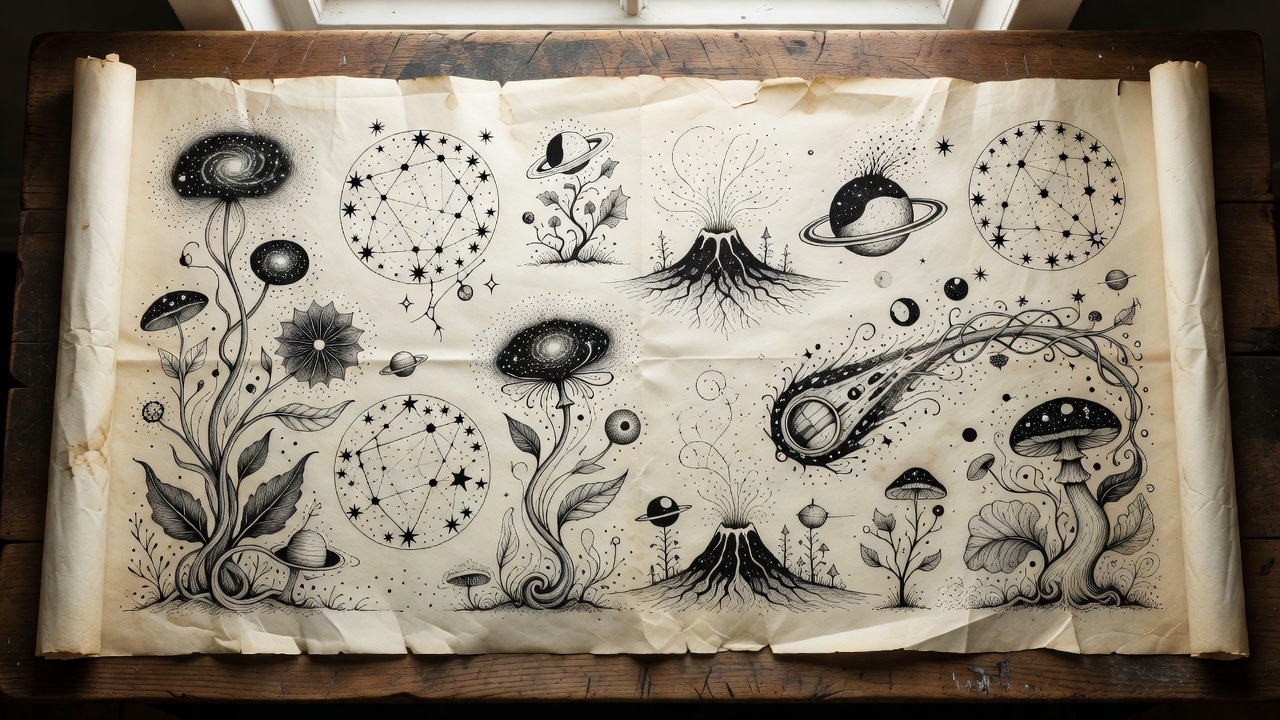
Housed in the climate-controlled vaults of the Beinecke Rare Book and Manuscript Library at Yale University under catalog number MS 408, the Voynich Manuscript represents the most elusive cryptological challenge in human history. Purchased in 1912 by Polish antiquarian Wilfrid Voynich from the Jesuit College at Villa Mondragone, the volume contains approximately 240,000 glyphs inscribed in a flowing, confident cursive that follows strict structural rules—yet conveys not a single universally accepted sentence.
Material Certainty vs Semantic Obscurity
In 2009, accelerated mass spectrometry carbon-14 dating conducted at the University of Arizona confirmed with 95% statistical certainty that the animal skins (calfskin vellum) were prepared between 1404 and 1438 CE. Raman spectroscopy by the McCrone Research Institute determined that the paints and iron gall inks are chemically consistent with Renaissance European preparations, decisively ruling out modern twentieth-century forgeries by Wilfrid Voynich or John Dee.
Yet, while the physical object is unquestionably genuine, the interior text defies every known linguistic taxonomy:
- Zipf's Law Conformity: The word frequency distribution in the manuscript mirrors that of natural human languages (such as Latin, German, or Mandarin) with extreme fidelity. Pseudo-random gibberish or arbitrary doodles typically violate Zipf's Law.
- Entropy Anomalies: The word entropy (unpredictability of succeeding characters) is significantly lower than Latin or English, exhibiting unnatural repetitive patterns (e.g., words identical to the previous word appearing with unnatural frequency).
- Zero Cross-Outs: The scribe wrote without a single erasure, correction, or pen hesitation, a feat near-impossible when composing enciphered substitution codes without a pre-existing plain text.
The Five Folio Categories
The codex is organized into distinct thematic sections based on its hundreds of bizarre, hand-tinted illustrations:
- Herbal (113 folios): Detailed botanical renderings of 131 species. Curiously, while European Renaissance herbals are readily identified, botanists have failed to conclusively match over 85% of Voynich flora to known living specimens.
- Astronomical & Astrological (25 folios): Circular celestial charts containing zodiac emblems, suns with radiating human faces, and concentric ring calendars.
- Balneological (20 folios): Naked female figures ("nymphs") bathing in interconnected plumbing networks, organic pipe conduits, and green liquid reservoirs.
- Cosmological: Elaborate fold-out diagrams, including a nine-fold rosette map spanning six pages depicting fortified towers and geological features.
- Pharmaceutical & Recipes: Hundreds of labeled apothecary jars accompanied by marginal roots and leaf fragments, ending with star-marked bulleted entries.
External Scholarly Reference & High-Res Access
High-resolution digital scans of all folios are curated by Yale University. Direct reference link: Yale Beinecke Digital Collections: MS 408 Voynich Manuscript.
Cryptanalytic Failures
During the Second World War, the legendary cryptanalyst William F. Friedman—who broke the Japanese PURPLE cipher—assembled an elite team of codebreakers to attack the Voynich script. After thousands of hours of manual index card frequency analysis, Friedman concluded only that the text was written in an early constructed language or an artificial a priori synthetic tongue.
In modern decades, recurrent neural networks, natural language processing models, and linguistic AI systems have proposed candidate languages ranging from Proto-Romance to Nahuatl and archaic Hebrew. However, each proposed translation matrix falls apart as soon as it is extended beyond a few isolated sentences. The Voynich Manuscript remains an impenetrable vault of Renaissance information.